In Singapore’s competitive retail and F&B landscape, capturing customer attention and delivering a compelling brand experience is more important than ever. While traditional static displays remain common, the rise of interactive touchscreen kiosks is changing how businesses engage with customers. Comparing these two methods shows why interactive kiosks are increasingly the smarter choice for boosting engagement and achieving measurable results.
The Limitations of Traditional Static Displays
Static displays, such as printed posters, banners, or non-interactive screens, have been staples in physical outlets for a long time. They are easy to deploy, low-cost, and straightforward. Yet they carry clear limitations.
They operate as a one-way communication tool. Customers observe rather than participate. The content is fixed, requiring physical replacement or manual updates to change messaging. In high-traffic or visually complex settings such as busy Singapore shopping malls or hawker centres, static signage often fails to stand out or capture meaningful interaction.
These displays also struggle to adapt to changing conditions. A lunch-time promotion may no longer be relevant by dinner. A printed sign cannot update itself. Moreover, they provide no analytics or insight into how effective the messaging is. When businesses aim to deepen engagement, static displays fall short.
The Advantages of Interactive Touchscreen Kiosks
Interactive touchscreen kiosks bring the potential to transform how customers engage, browse, and interact with content. They offer a two-way experience. Customers actively engage with content, rather than passively consume it. This shift boosts dwell time, memorability, and ultimately drives better conversion rates. In Singapore’s F&B and retail environments, these benefits are particularly relevant.
Key benefits include:
- Dynamic content: Kiosks allow content to change instantly. Promotions, menus, recommendations can update based on time of day or specific campaigns. This keeps messaging relevant and proactive.
- Improved customer experience: In a high-foot-traffic F&B setting, self-ordering or way-finding kiosks reduce queue time, improve order accuracy, and create a smoother flow.
- Data and analytics: Touchscreen kiosks can track user behaviour, including what customers browse, select, and how long they engage. These insights help refine campaigns, optimise layouts, and improve return on investment.
- Immersive and interactive design: Videos, animations, interactive menus, and multi-language support help capture attention in a crowded visual field. For a multicultural market like Singapore, this is a significant advantage.
- Brand engagement: Touch-based interfaces make customers feel involved. They become part of the experience, not just observers. This builds emotional connection and improves recall.
Case in Point: Kopitiam “Kimberly” at Punggol Coast and VivoCity
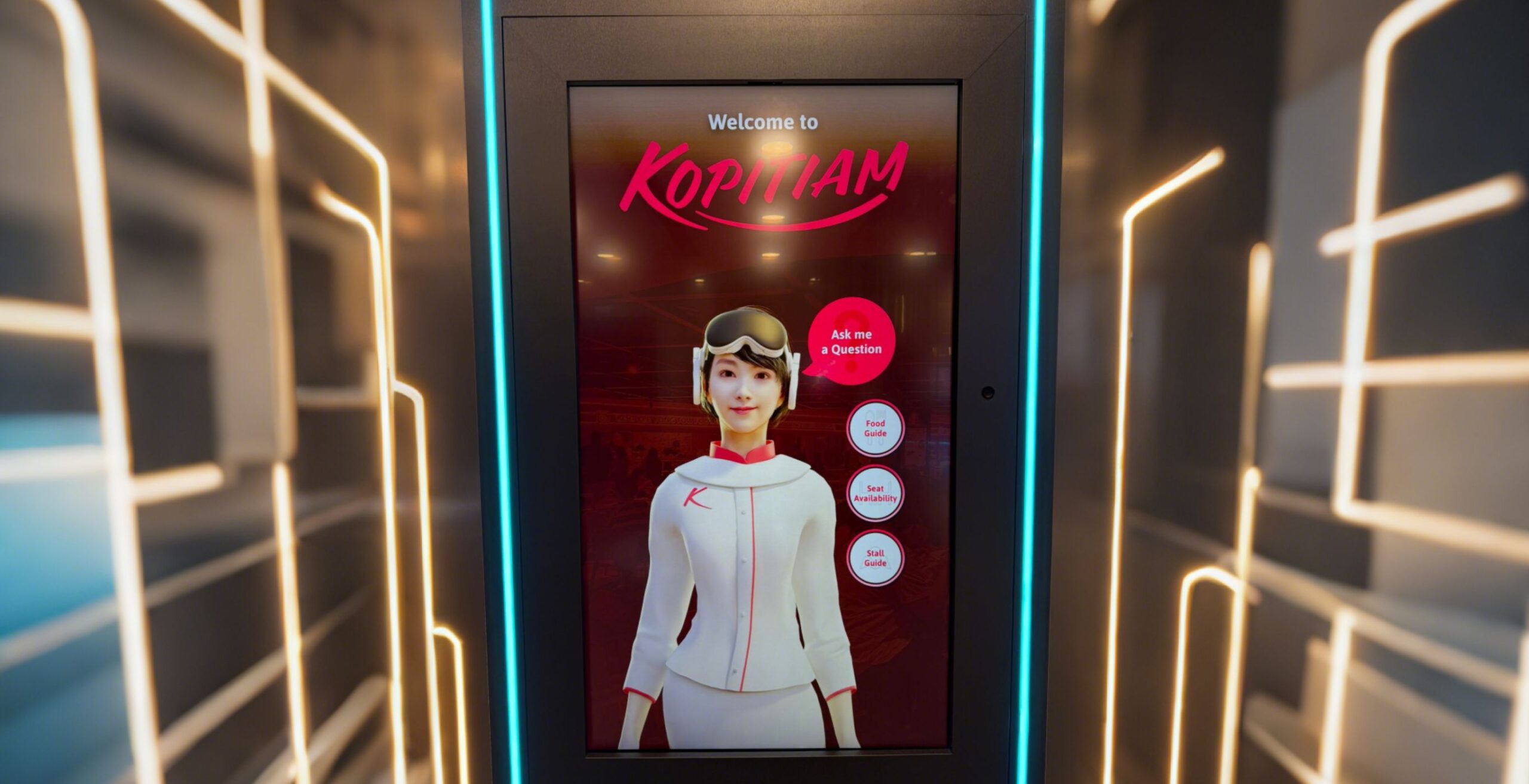
A real-world example illustrates these benefits clearly. At Kopitiam’s locations in Punggol Coast Hawker Centre and VivoCity, the rollout of an AI-powered kiosk assistant called “Kimberly” demonstrates how interactive kiosks outperform static signage in engagement and operational benefit.
Kimberly, Singapore’s first multilingual food court assistant, greets diners, answers questions, and guides them through the food court using voice, touch, and real-time data. The system displays live seat availability and highlights promotions and stall recommendations through synchronized digital screens. A network of kiosks and screens integrates with customer flow analytics, including footfall, queue length, and seating patterns, enabling Kopitiam to not only engage customers but also optimise operations.
This deployment highlights several interactive kiosk benefits, including a branded, memorable experience, active customer participation, real-time adaptability of content, and strong data feedback. These outcomes are not possible with static signage alone.
Comparing Engagement: Interactive vs Static
When comparing interactive kiosks and static displays side by side, several distinctions emerge.
With static signage, engagement is low. Customers may glance at it, but they rarely act. With an interactive kiosk, the interface invites participation, which leads to longer dwell time and better recall.
The ability to update, tailor, and personalise content gives kiosks an edge for relevance. Static signage cannot pivot based on context or audience. Analytics and feedback loops allow interactive kiosks to continuously improve. Static displays offer no such insights.
In a high-density environment like Singapore, where consumers face information overload, interactive kiosks cut through the clutter by offering a unique, engaging experience rather than blending into the background like static signage.
Why Singapore Businesses Should Consider Interactive Kiosks
Given the environment in Singapore, including dense urban retail zones, high expectations for service speed in F&B, and multilingual audiences, businesses that deploy interactive kiosks gain significant advantages.
They can stand out visually and experientially in crowded spaces. They offer relevant, personalised content and engagements tailored to user needs. They improve service and operational efficiency, especially in F&B, where queue reduction and self-service are priorities. They provide data-driven insight that enables better decision-making and measurement of return on investment. They enhance brand presence and customer satisfaction, leading to repeat visits and stronger loyalty.
Traditional static displays still have a role in simple messaging, but the value proposition clearly lies with interactive touchscreen kiosks. They deliver superior engagement, operational value, and measurable data advantages. For companies in Singapore’s retail and F&B sectors looking to elevate brand experience and customer interaction, investing in interactive kiosks Singapore is a strategic step worth taking.
Static signage may be familiar and low-cost upfront, but when evaluating true value, including engagement rates, conversion, customer satisfaction, and data insights, the benefits of touchscreen kiosks become undeniable. When combined with strong content strategies and analytics, interactive kiosks are essential for modern brand engagement.